Three Use Cases for Rollups: Futures, Games, and Cross-chain Swaps


In three months' time, there will be Optimistic Rollups with the ability to run a node with any virtual machine on top of Tezos. And then, there will be ZK rollups with instant state finalization.
We wondered what decentralized applications in other blockchains already use rollups and now present a selection of such cases.
Decentralized Futures With Leverage
Decentralized exchanges are free from several drawbacks of centralized platforms:
- custodiality: although the user makes a deposit on L2 to trade, the balances are displayed in the blockchain browser without any Proof-of-Reserves;
- anonymity: to work with such a DEX, you only need to connect a wallet, not specify your email, and pass KYC;
- self-governance: with the DAO, you can manage the project’s development.
dYdX is a decentralized platform for trading perpetual futures with 20x leverage. It accepts deposits on a smart contract and executes trades in a ZK rollup, although it stores the order book on a centralized server.
The interface looks almost identical to that of centralized exchanges.
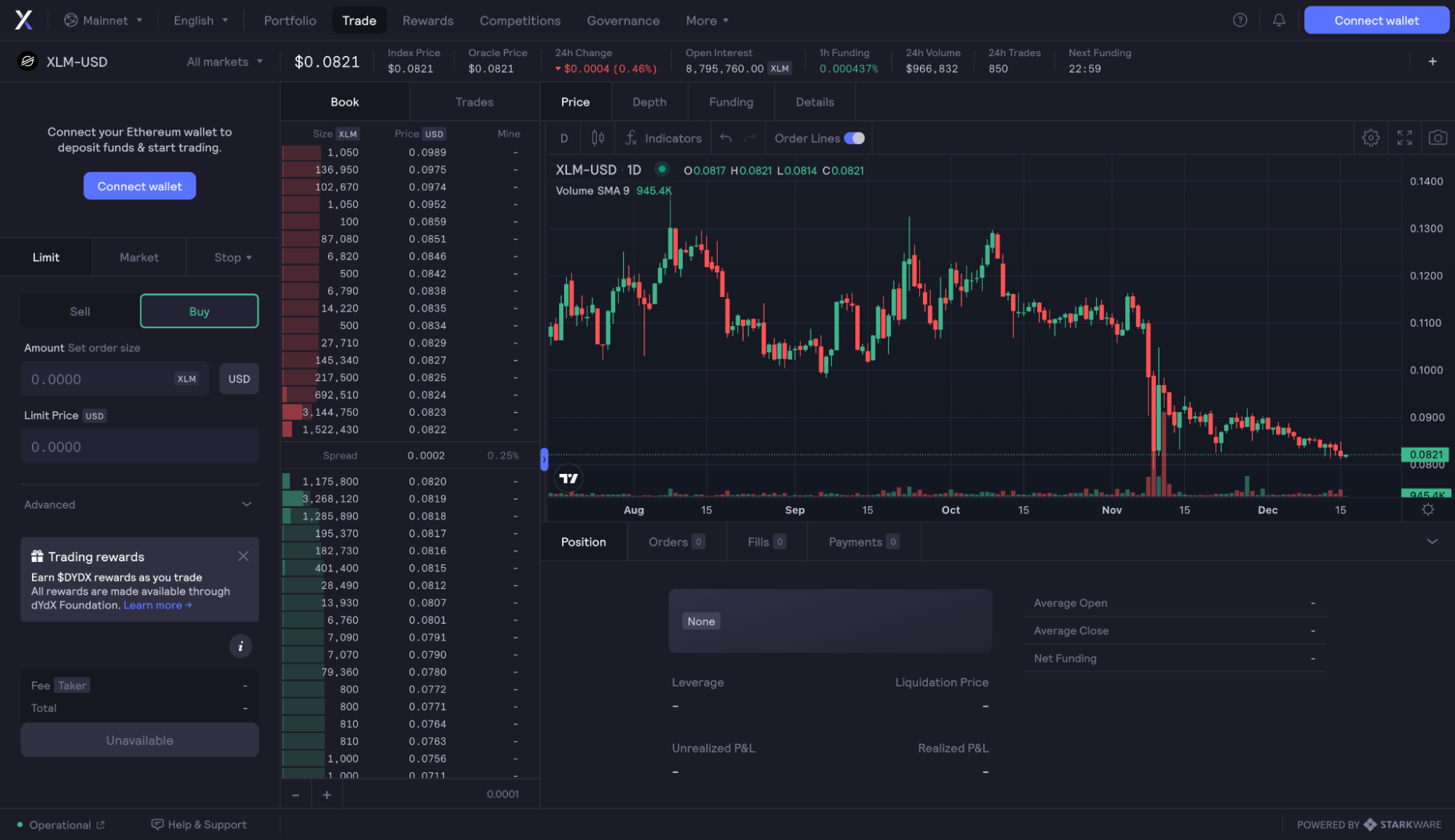
The speed of order matching is up to 10 trades per second. Thanks to ZK-STARK technology, the exchange only records changes in traders’ balances in L1 but not their transaction history.
In addition to dYdX, there is also ApeX and several other derivatives exchanges on L2.
(Almost) Free Decentralized Games
The problem with using blockchain in games is that you have to pay for each transaction, wait for the smart contract to be called, and for the transaction to appear in the next block. In SalsaDAO Gaming Hall, for example, up to two minutes pass between the dice roll and the result’s appearance.
With rollups, developers can achieve transaction execution within a second and reduce transaction fees to almost zero.
For example, the ImmutableX platform based on ZK rollups provides players with free minting and low-commission NFT trading. The cost of using rollups is built into the commission of the most popular transaction, selling NFTs.
Game developers use rollups as a decentralized repository for in-game assets. Free minting allows them to lower the entry threshold for players, e.g., selling basic NFTs for $0.01. Therefore, developers often describe their projects as Free-to-Own rather than Play-to-Earn.

Judging by the projects on ImmutableX, rollups can be used to implement any NFT-related mechanics: from owning every unit in a strategy game to creating unique characters in action games by combining character tokens.
Some games, like football and basketball team owner sim Sorare, run their own rollups for the same purpose. In Sorare, you often need to build teams of NFT players, so the developers switched it to ZK rollups to lower transaction fees and get a throughput of up to 3,000 TPS.
Cross-chain Exchanges
We are used to cross-chain bridges that accept tokens on one protocol and issue wrapped versions of them on another. Cross-blockchain transfers are expensive, require trust in the bridge validators, and do not allow active trading between protocols.
Rhino.fi, based on ZK rollups, has launched cross-chain swaps between EVM-compatible blockchains without paying transaction fees on the destination chain. A user makes a deposit into a rollup on a supported blockchain and chooses which token they want to exchange their funds for and on which network. The protocol finds a suitable request in the order book and executes it. As a result, the user takes possession of the right tokens on the right blockchain and can withdraw them to the appropriate wallet.
Subscribe and never miss updates from the world of Tezos:
- Telegram channel
- Twitter in Russian and Ukrainian
- Twitter in English
- YouTube channel
- hub at ForkLog
next
Details of the Mumbai upgrade: rollups in the mainnet and block backing in 15 seconds!


